

To create access, we first need to break down the barriers. Check out the blog post on Common Disability Barriers.
To make accessibility a reality, we must remove the hindrances preventing us from getting there.
Do you know people living with disabilities experience the world in a vastly different way from the way people without disabilities experience the world?
People with disabilities experience limited access including exclusion from activities and services those without disabilities take for granted. They face insurmountable tangible and intangible barriers that keep them from full participation in various parts of society.
People with disabilities experience limited access including exclusion from activities and services those without disabilities take for granted. They face insurmountable tangible and intangible barriers that keep them from full participation in various parts of society.

Our last blog looked at the common existing disability barriers. This blog will look at how we can help remove these existing barriers and proactively remove/prevent barriers and create access. Before we dive into the topic, we need to understand the following terms that will occur throughout this article.
Barriers
In general –
A barrier is anything natural or manmade that limits or obstructs passage, access, progress, etc.
Disability barriers defined by the World Health Organization (WHO) –
Factors in a person’s environment that, through their absence or presence, limit functioning and create disability. These include aspects such as:
- a physical environment that is inaccessible,
- lack of relevant assistive technology,
- negative attitudes of people towards disability, and
- services, systems and policies that are either nonexistent or that hinder the involvement of all people with a health condition in all areas of life.
For this blog –
A disability barrier is anything that prevents an individual with a disability from fully and meaningfully participating in all areas of society because of the individual’s disability.

Accessibility
In general –
the quality of being easy to reach, approach, enter, obtain, use, communicate with, or understand
In the context of disability rights –
Accessibility means that a person with a disability is afforded the opportunity to acquire the same information, engage in the same interactions, and enjoy the same services as a person without a disability in an equally effective and equally integrated manner, with substantially equivalent ease of use.
For this blog –
The degree to which a place, product, service, policy, procedure, program, device, technology, environment, or information is equally available to all people.
Access
In general –
The ability, right, privilege, or permission to approach, reach, use, speak with, or acquire
For this blog –
An individual’s ability to enjoy all the benefits and rights as a full member of society.
Now that we have our terms defined, let’s dive into some practical solutions to creating access.

Physical accessibility
Physical or architectural barriers are the most noticeable. In fact, the accessibility of a building or space often conveys the value and attitude an organization or institution holds toward disability.
Some examples of physical features that help people with disabilities enter and get around a building or space:
- designated parking for people with disabilities
- access ramp or level building entrance
- accessible and wide sidewalks
- automatic doors and wide entryway
- well-lighted and wide aisles and hallways
- accessible bathrooms
- elevators or lifts
- good lighting in the building
- Braille signage
- clear and easy-to-read signs throughout the building
- good ventilation
- accessible shelves, service counters, writing surface
- unobstructed walkways
- color contrast
- tactile pavings
An organization or business can also provide auxiliary services if changing existing physical features is difficult. For example, a business or organization can have:
- greeters to open the door for people
- clear signs directing people to nearby accessible bathrooms
- staff members retrieve items for hard-to-access shelves, counters, or aisles

Preventing Barriers
Instead of being reactive, designers of a new space can be proactive to prevent physical barriers in the first place. They can design buildings with more expansive entryways and walkways, good lighting, color contrasts, and elevators. The most important thing is to consult people with disabilities during the design process to ensure physical accessibility.
Participation in social life requires presence. Therefore, physical barriers often receive the most attention since a lack of accessible spaces can limit a disabled person’s ability to be present in many social scenes. Though remedies for the structural barriers may seem straightforward, they often require leaders to prioritize changes and improvements intentionally.
Attitudinal accessibility
Attitudinal barriers for people with disabilities are often the most challenging to overcome. Many people are unaware of their bias and prejudice toward people with disabilities. Many of the attitudinal barriers may be subtle or convert. Still, they do not go undetected by people with disabilities and their families.
There are many ways we can help remove the attitudinal barriers by fostering a welcoming and accepting environment:
- Avoid making assumptions about a person’s abilities or disabilities.
- See past a person’s disability diagnosis and seek to know the person with disabilities.
- Do not patronize people with disabilities.
- Educate yourself about disability-related issues.
- Use person-first language.
- Treat them as you would like to be treated.
- Respect them as people with inherent worth and dignity.
- Befriend people with disabilities.
- Include people with disabilities in social networks.
- Consult people with disabilities when making decisions affecting them.
- Ask the person with disabilities if you are unsure about the appropriate etiquette or the person’s preference.
- Be an advocate for the disabled community.
Systemic accessibility
Systemic barriers are governmental or organizational policies, procedures, or practices that limit, or even deny, access for people with disabilities. Some of these barriers have existed for some time and may not be easily removed. But we can still do certain things to include people with disabilities:
- Consider accessibility when planning for events or activities.
- Make reasonable adjustments to the work environment to help employees with disabilities succeed in their roles.
- Accommodate the specific needs of students with disabilities to facilitate their learning.
- Review hiring policies to encourage people with disabilities to apply.
- Provide access to mass transportation.
- Optimize processes, procedures, policies, and environments to meet the needs of all people.
Communication accessibility
Communication accessibility involves both sending and receiving information. We live in an information age. Therefore, barriers to communicating or accessing information will result in undue disadvantages for people with disabilities. The good news is that there are many ways we can help remove the barriers and make information accessible to people with disabilities.
- Listen actively and give the other person your full attention.
- Be patient and allow the other person enough time to communicate.
- Use clear, concise, and easy-to-understand language.
- Avoid complex language or jargon.
- Offer information in different formats (i.e., written, electronic, etc.)
- Use appropriate font size and type in printed materials.
- Provide captions and transcriptions to videos.
- Use graphics or charts to make complex information easy to understand.
- Do not pretend to understand; be honest if you cannot understand the other person.
- Include Braille on signs throughout the building.
- Offer interpreter services for the deaf community.
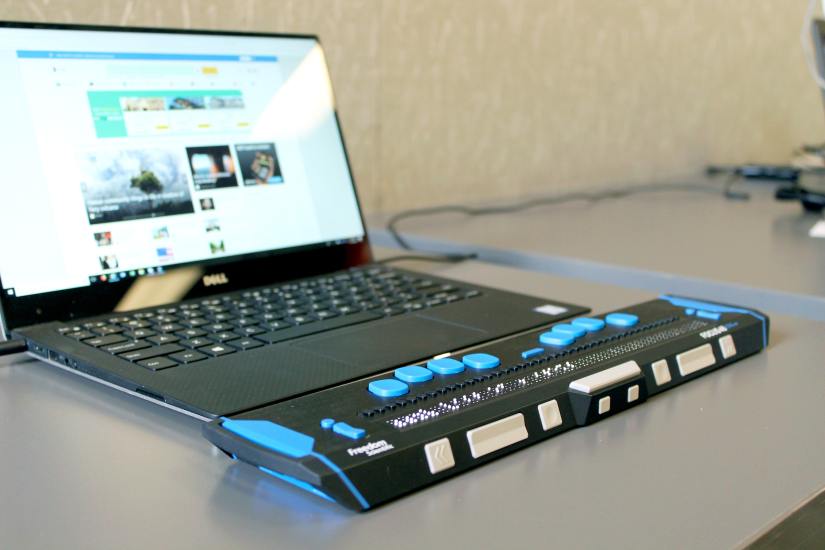
Technology accessibility
Technology has provided many benefits for the disability community. It enables people with disabilities to work remotely, access learning opportunities, improve communication, and enhance community connections. However, we can further break down the technology barriers with the following strategies:
- Utilize web accessibility tools.
- Use alternative text and photo description tools to ensure electronic communications are accessible to everyone.
- Add voice synthesizer to computers.
- Incorporate screen-reading software.
- Use websites that meet accessibility standards.
- Choose digital textbooks when appropriate.
- Choose equipment with screen magnification and speech recognition.
The benefits of accessibility
Accessible public transportation encourages people with or without disabilities to do everyday activities without having to operate personal vehicles. This helps reduce pollution and enables people with disabilities to go out and interact with others.
Accessible technology enhances communication, education, and employment opportunities for people with disabilities. This opens up learning and work opportunities for people with disabilities, leading to gainful employment and improved quality of life.
Accessible services (libraries, healthcare, banking, retail, etc.) enable people with disabilities to conduct everyday activities more conveniently, motivating them to lead independent lives.
Accessible leisure, sport, or cultural events allows the disability community to participate in social activities and interact with larger communities.
Improved accessibility creates opportunities for social integration, encourages people with disabilities to actively participate in society, and empowers them for independent and quality living. An accessible society benefits not just the disabled community but all members of society.